
Each credit card has a unique set of credit card numbers. The same applies to a debit card, gift card, or retail card you may own. These various numbers are used to identify the financial institution, the payment network, account number, and security protection numbers.
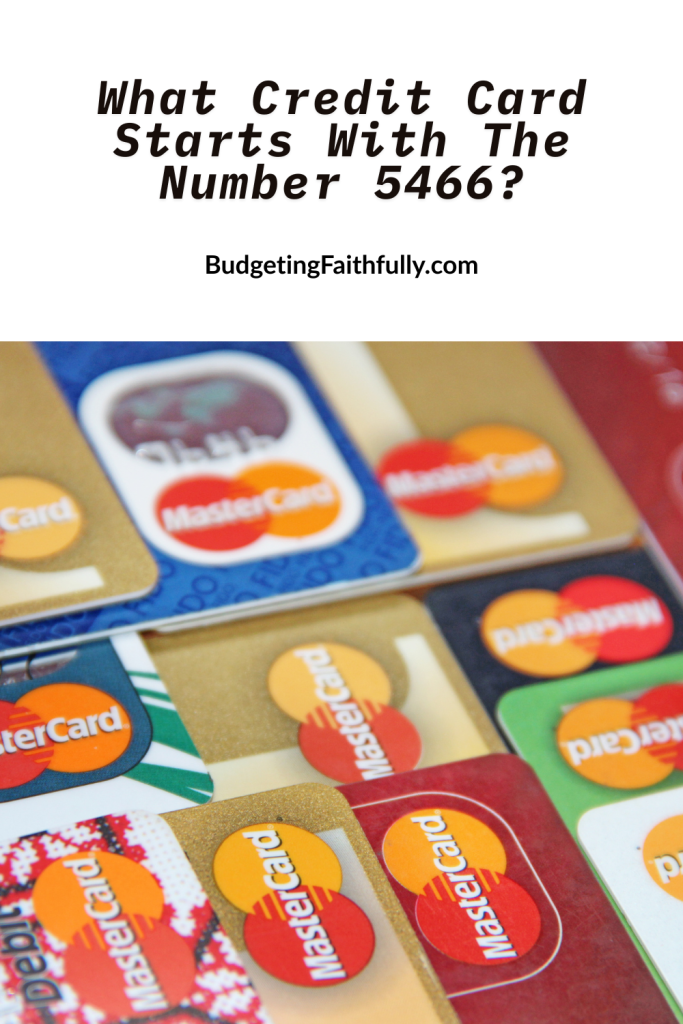
These basic numbers are the framework for every credit card issued today. If you have multiple credit cards they can help you manage your credit by assigning each card to a specific type of purchase. This is an excellent budgeting tool to help manage your purchases. Therefore, your credit card numbers can be used to ensure they are used based on your budget. What credit card starts with the number 5466? It is the Mastercard.
Mastercard numbers range from 51 to 55. Diners Club cards issued in Canada and the United States use 54 or 55. They are treated as Mastercards worldwide. Each credit card has a unique number that identifies them. American Express numbers start with a 3. A Visa card has a 4. Each credit card has a total of 15 or 16 digits. American Express has 15 digits and Visa, Discover, Diners, and Mastercard have 16 digits.
Let’s take a deep dive into every part of the credit card number including the Issuer Identification number, bank identification number, the Major Industry Identifier, major credit card networks, account number, and how the Luhn Algorithm uses the fraud digit.
The Major Industry Identifier
The first digit on the credit card identifies the industry. The Major Industry Identifier Number (MII) has about nine different sectors. Most people are familiar with at least four or five of them. We will focus on Number five—Mastercard and Diners. Like the Visa Card, they are in the banking and financial services industry.
1 and 2: Airline and financial services.
3: Travel and Entertainment (includes American Express Card).
4: Banking and financial (includes Visa Credit Card).
5: Banking and financial (including Mastercard and Diners).
6: Merchandising and banking (includes Discover).
7: Petroleum.
8: Healthcare and telecommunications.
9: Government or other.
Issuer Identification Number or Bank Identification Number
The Issuer Identification Number(IIN) or Bank Identification Number (BIN) is the next five or seven digits on the credit card after the first digit. The standard for the BIN ranges was six digits. However, as of April 2022, Visa and Mastercard began to issue BINs with eight digits. Therefore the new standard is six to eight digits.
These numbers identify the card issuer. The Card Issuer could be a bank institution like Citi, Chase, or Wells Fargo. A credit union or a retail establishment can also be a Credit Card Issuer. You can check your BIN number using this Bank Identification Number Search for your credit cards. There are 300,000+ unique numbers stored in this Bank Identification Number Database. Please note this database is accurate but not perfect. Use it at your own risk.
Account Number
The account number will be the next nine to ten numbers. The issuing bank assigns these numbers to the customer. Each financial institution has an unlimited supply of account numbers for their customers. Therefore, financial institutions with access to unlimited numbers make it very easy to replace lost or stolen cards.
The Last Digit
Finally, we come to the final digit of the credit card number. This digit is crucial because it allows the banks to verify and validate a credit card number. The process that is used is the Luhn Algorithm or Modulus 10. The algorithm was developed in the 1960s to prevent fraud. When the check number is added to the rest of the numbers on the credit card, the sum should equal 0. If the wrong number is entered online the transaction will be denied, because the sum will not equal zero.
Total Digits for each Card
There are 16 digits of a Visa Card, there are 16 digits of a Mastercard, 15 digits of an American Express Card, And 14 digits of a Diners or Carte Blanche Card
Other parts of a Mastercard Credit Card
Front of the card
- The Smart Chip
- The Banking Branding
- The Payment Network Logo
- The Cardholder’s Name
- Card Verification Value (CVV) – a four-digit number used by American Express
Back of the card
- A Unique Card Number
- The Expiration Date
- A Signature Box
- The Magnetic Strip
- A Card Identification Number (CID) – a three-digit number.
- The Financial Institution or Bank’s Contact Numbers
However, the location of the above information may vary based on the type of card. For instance, most retail cards have some of this information on the front of the card, not on the back.
The Major Credit Card Networks
Mastercard and Visa are credit card networks. Banks and other financial institutions license one or both card networks and are the credit card issuers. Mastercard and Visa do not directly issue cards to individual consumers. The banks and other financial institutions issue Mastercard or Visa-branded cards. These licensed institutions are responsible for issuing credit cards and setting the terms of use by setting interest rates, fees, and additional perks for their financial product.
The major credit card networks are intermediaries between the card issuer, cardholders, and merchants to ensure secure and effortless credit card transactions. Their job is to provide the network for payment processing. They ensure every transaction is authorized and the funds are transferred to the correct parties.
Here are the steps taken to ensure each transaction is effortlessly and quickly executed promptly:
Authorization
When the consumer uses their credit card the Merchant’s bank sends a request to the credit card network to authorize the transaction.
Issuer Communications
The card network then contacts the card issuer (the bank or financial institution) to verify the transaction and check for available funds.
Approval/Denial Process
The issuer approves or denies the transaction based on its policies and the consumer’s credit limit.
Transaction Completions
The network then sends the bank’s response to the merchant’s bank allowing or denying the transaction.
Settlement
If the transaction is approved the transaction is completed. The network then transfers the funds from the issuer to the merchant’s bank.
Fees and Regulations
The credit card network also sets the interchange fees they charge each merchant for processing the transactions. They establish all the rules and policies that govern the network process. All participants are required to follow.
The approval process at the point of purchase can take a matter of seconds. The completed process can take up to one to three business days. Meanwhile, the transaction can show as “pending” on your account initially but will post as final by the third business day. However, some transactions will appear on your account immediately.
This all depends on the bank or credit card issuer’s processing time. The payment network also has a processing time which can delay the completion process. Finally, the type of transaction will determine if the process completes faster than three business days. Most merchants typically receive their funds within one to three business days.
Budgeting By Numbers
Since the digits of a credit card number identify the type of card you have why not use it to keep track of your purchases? I tend to use the same card when I purchase items online. Therefore, I choose one that is the most helpful when disputing fraud from unauthorized purchases and if I wish to receive a speedy refund when I make a return. I use a different card for household expenses to make budgeting and payments convenient and easy.
Gone are the days of sitting and writing out checks for every bill. Direct payment takes care of the tediousness of paying bills. Finally, I use a separate card for vacation and entertainment. Putting categorized purchases in their specific payment card helps me stay on budget and in most cases earn reward points.
Another perk of using credit cards for budgeting is setting up notices for every transaction. This will alert you to any unauthorized use of your card so you can quickly alert your bank of fraudulent activity. Finally, each card is set to pay each balance in full. You must ensure funds are in the checking account and can cover every credit card balance. I am very good at only spending what I can afford to pay off each month. I like to set up spending alerts for each card so my bank can notify me when I am close to reaching my budgeted limit. This has successfully worked for me for years.
Recap: What Credit Card Starts With The Number 5466?
Mastercards start with the 5466 number. However, the digits of a credit card hold a great deal of information used to identify the bank or financial institution, the payment system, the cardholder’s account number, and a check digit system to verify that the number entered online is accurate. However, the first number will always identify the industry. The next five or seven identify the banking institution whether it is a bank, credit union, or retail merchant. The remaining nine to twelve numbers are the account number. The last digit is the check digit for the Luhn Algorithm. You can use the BIN Identification Number Search to locate the bank for any credit card.
Knowing your credit cards by number can help you maintain your budget, detect fraud, and work with the financial institution that will best help you with any disputes you have with the merchant. Finally, if you are disciplined use your credit cards to help you execute your budget. Put as many safeguards in place to ensure that you do not overspend.
Credit Card Perks
The digits of the credit card number are not the only thing that differentiates these from one another. There could be special deals, additional fees, interest rates, reward programs, cash back, and points programs to use against your current balance or to make purchases. There could be an offer for a balance transfer to a lower interest rate, such as zero interest for a year. The banking institution could offer a mobile device to review balances, available credit, current credit scores, and the ability to freeze your card when you are not using it. Finally, they may have convenient branch locations should you need to address an issue in person.
The ability to find the best credit card for you should check off the following boxes:
- Accepts your current credit score
- Provides the best interest rate that you can afford
- Has excellent customer service for disputes and/or refunds
- Provides the perks you need the most i.e. cash back, point system, travel perks, etc.
- They have additional financial products such as balance transfers that save you money
- They can replace lost or stolen credit cards promptly
- You can set up automatic payment to pay your balance in full each month (this will keep you out of debt)
- Have convenient bank locations
This content is for information purposes only. It does not constitute financial advice. If you need personal advice, please consult a financial advisor. Please research and do your due diligence. I do not get paid if you click any of the links.
Additional Reading…
Easy Answer: What Credit Card starts with 4147?
What Credit Card Starts With 4400
Discover What Credit Card Numbers Starts With 6011
What do CID and CVV mean on a credit card?
Credit Vs. Debit Card And The Processing Fees